
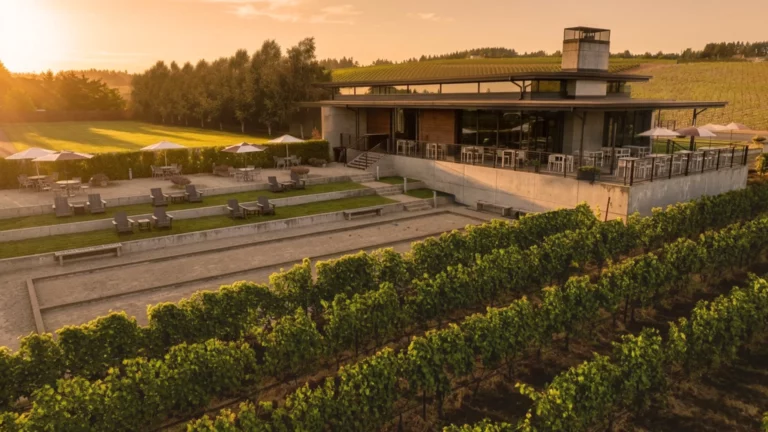
Ponzi Vineyards
As the climate shifts and old vines adapt, Maison Bollinger bets on an Oregon identity still waiting to be discovered
written by Erika Mantovan
There is a before and an after Bollinger’s acquisition of Ponzi Vineyards. And for anyone wondering whether the Champagne house plans to make sparkling wine in Oregon, the answer during our visit was a “no”: that was never the intention from the start. The aim of the investment is a vision of the potential of a rising region for still wines, a sustainable approach to the vineyard, the family, and the seriousness of the project. These are the real levers that moved the house famous for having James Bond drink its Champagne to invest in the Laurelwood District AVA.
Winemaker Max Bruening, the first from outside the family to lead the cellar, who tells us about his wines with real passion, confirms Oregon’s potential when it comes to climate: this year, July was the second coolest since 2015, with only four days above 90°F (about 32°C), compared with around fifteen last year.
A climate that is rewriting the calendar
Summer 2026 has followed a bell-curve pattern: temperatures sitting in the mid-to-upper 70s, creeping up to a peak of about 94-95°F, then dropping right back down. A breather after seasons that forced a rethink of everything. “Every year, more and more, we are seeing that window open.”
This year bud break came two weeks early and bloom a week to a week and a half early. In 2025 harvest ran from September 1st to September 28th, “very compressed“: ten years ago picking began around the 11th, with a little fruit for sparkling wine. 2022 was the first year with a hard late frost, at the end of April: some sites were hit very hard, others hardly at all. With bud break at the end of March, “you’re not out of all the sporadic winter,” like the cold snaps that come down from Canada. And the problem is harder now that the vineyards are organic: in 2026 Ponzi obtained CCOF certification (CCOF certification (the leading organic guarantee mark in the United States, issued by an independent body, certifying compliance with strict USDA Organic standards, with no GMOs or synthetic pesticides throughout production).
The response is agronomic and in the cellar. For the winemaker, “the heat isn’t going anywhere,” so he works with Pinot Noir at lower pH. In the vineyard he is rediscovering the heritage clones, which ripen well in a warmer climate and “you never lose that acidity”: a tool to bring a wine back into focus, with an “intentional linearity.” He also looks to geography: “If we want to continue to do that here, we need to plant higher and we need to plant closer to the coast.” The most recent vineyard bought by the family, the furthest west and highest in elevation, points in that direction: roughly every decade the Ponzis buy a new one, looking to where the climate is heading. All producing vineyards remain dry-farmed, with no irrigation.
The wind helps. At Ponzi, on the northeast side of the Chehalem Mountains, it doesn’t come from the Van Duzer Corridor as it does in Eola-Amity, but from the Columbia River Gorge, from the north: “it helps move stagnant air around” and favors thicker skins, and so more tannin.
History: from pioneers to Bollinger
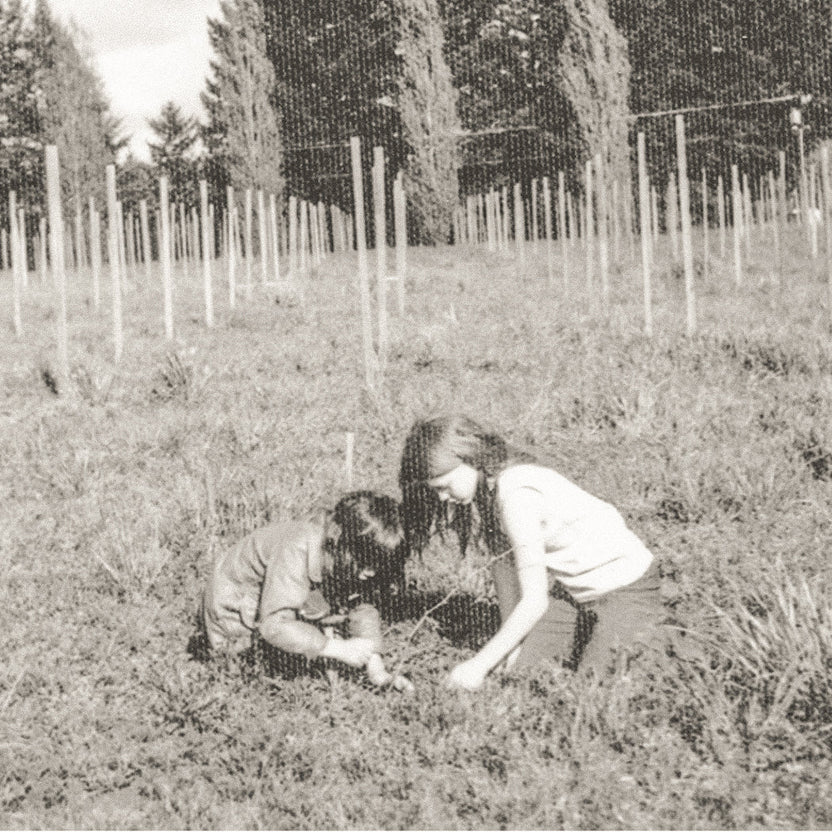
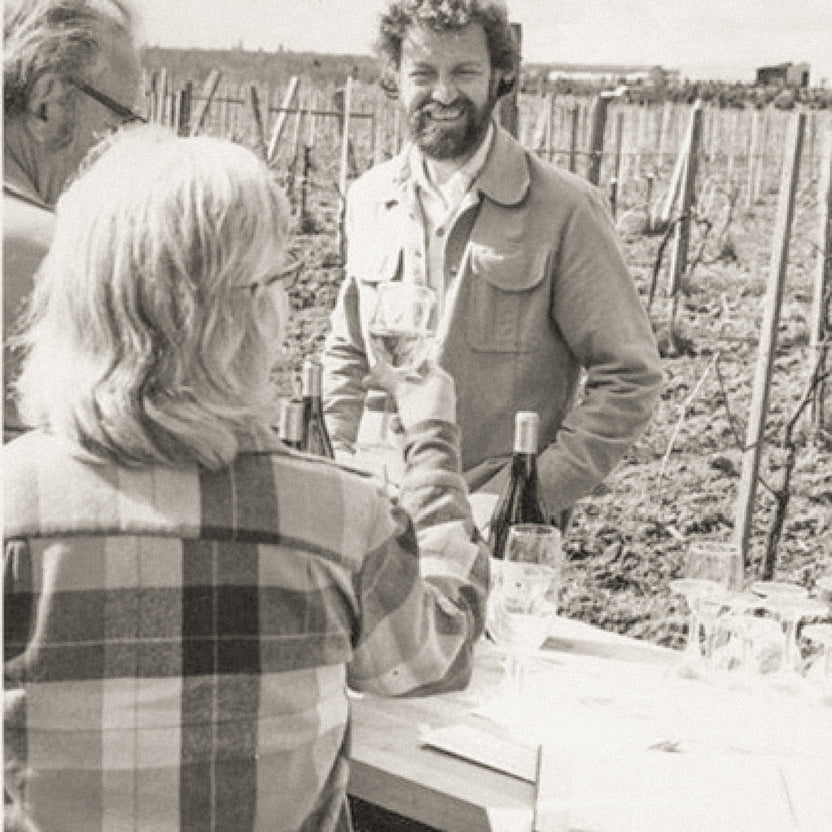
Dick Ponzi left California, where he was an engineer on “the Disney teacup ride,” and moved to Oregon in search of a cooler climate, inspired by the wines of Alsace, “before there was even an industry.” The winery was founded in 1970. The first vineyard in what is now the Laurelwood District, Abetina, was planted in 1975. In 1981 came the first commercial Pinot Gris in the United States. The 1983 Pinot Noir Reserve is the one that, they say, changed Parker’s perception of Oregon: “a reference point for American Pinot Noir.” The sustainability path began in 1997 and led to LIVE certification in 2000, three years later. In 2020 Laurelwood became the first American AVA defined by geology and not just geography.
Bollinger arrived in 2021, its first acquisition outside France. “It was as much about the brand as it is about the land itself.” The family had been looking in Oregon “for many, many years,” and the deal “would have never happened without the nod of approval from Dick and Nancy Ponzi, because this is their legacy.” They had to be sure that philosophy and approach to farming, people and wines were in harmony: “a link of people and vision.”
What has changed with the French Champagne investment
In practical terms: for four years Ponzi has been working with the pruning consultants Simonit&Sirch, who came into the vineyards with the acquisition: “in a year’s time, we saw the difference.” One result: Madrona came back in 2023 as a single vineyard for the first time since 2016. In 2024 a complete Bucher Vaslin processing line with an optical sorter arrived, and sorting moved from cluster to berry: with massal selection the parameters have to stay “a little bit more liberal” so as not to reject viable fruit, and the focus falls on pigmentation, watery berries and secondary fruit set. The barrels are the same, but matched to specific vineyards instead of one blanket approach: “Barrels are a structural, foundational framework. They should not define the wine.”
How much has France influenced things? “The biggest impact for me is how little involved they are, in the sense of how much they trust us to do the right thing.” The winemaker admits he was expecting worse: “I was waiting for it to happen. Just waiting… when do I have to wear high-vis?” And on why foreign capital matters: “We have 200+ years of history, we know what works, what doesn’t work.” Partly because there is “a very Oregonian pride” that doesn’t want to be influenced by success elsewhere, and fifty years ago “there was so little cross-collaboration between New World and Old World.” The next challenge is taking Oregon beyond Oregon: “If one person in Oregon drinks one less bottle a year, then we need to replace that bottle somewhere else.”
Old vines, own-rooted
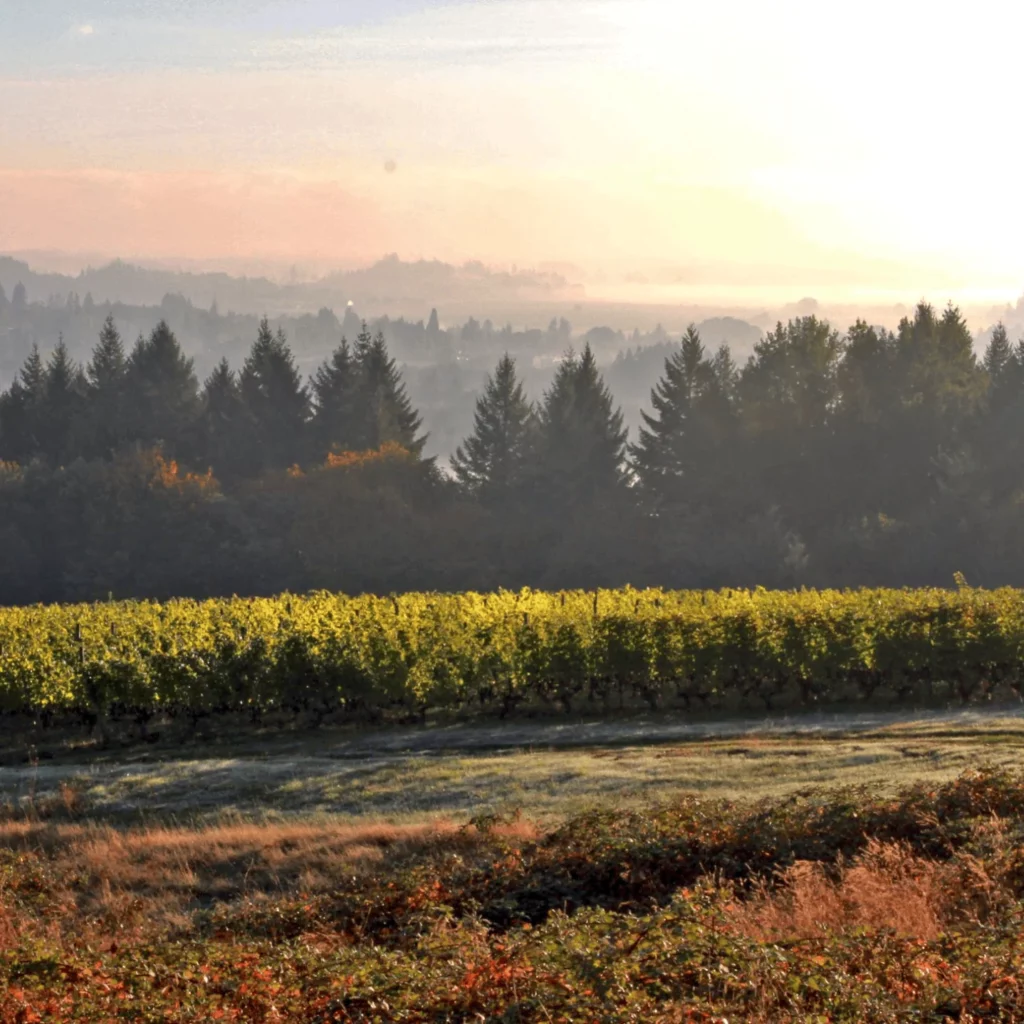
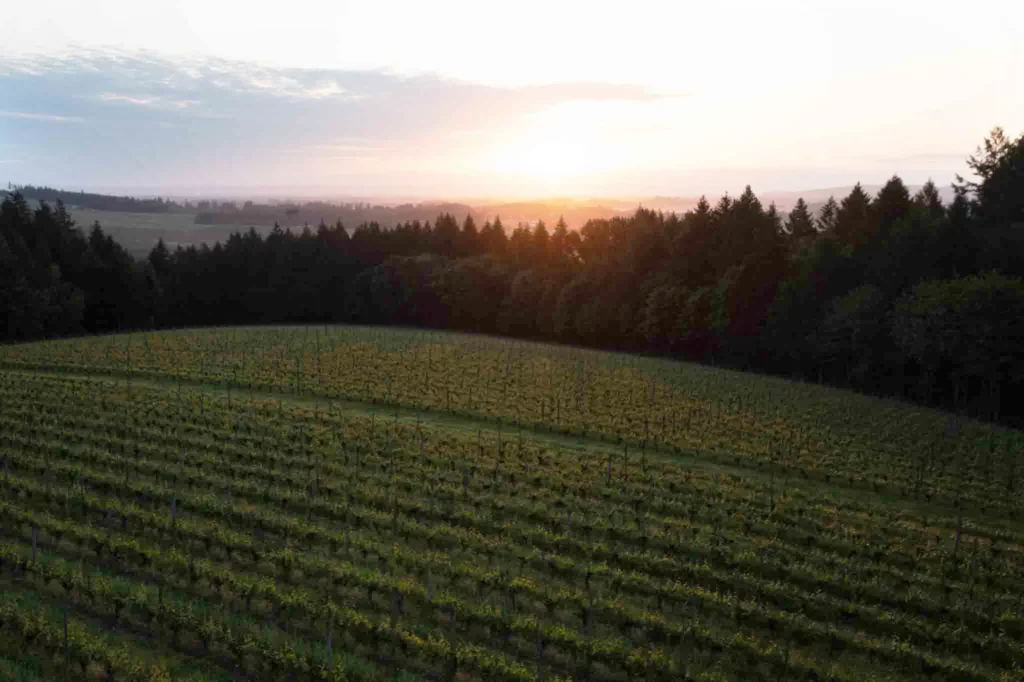
The heart of the estate is its historic vineyards, still own-rooted and never touched by phylloxera. “We are still farming and producing wine out of the original Ponzi cuttings.” The average vine age is 35-37 years, and there are 140 acres (about 57 hectares) in production, together with the family, with grape growers who have worked with Ponzi for over thirty years. The estate manager has been with the Ponzis for more than 45 years: “institutional knowledge is everything.” Luisa Ponzi, who has left the cellar, still leads viticulture: “I talk to her every day.”
Abetina began as an experimental vineyard with Oregon State University: “It was a laboratory,” out in the elements, in colder and wetter conditions, where the fruit did not ripen every year (“you were lucky if you did“). The results from there are why Pommard is still among the most planted clones in the valley. To protect that heritage from the risk of phylloxera, the Ponzis took cuttings from every single vine at Abetina and grafted them into another block, within Aurora (planted in 1991), at the same elevation and with the same exposure: another Abetina block. Madrona, planted in 1983 on the same hill as Abetina, is Dijon and Pommard, all own-rooted.
In the more recent vineyards the approach is massal selection: “22 Pinot clones planted, intermixed like wildflowers, so we don’t know what is what. It creates a balance and a consistency and a profile very specific to Ponzi and no one else. It’s something that you can’t achieve in the cellar, it can only be achieved in the vineyard.”
Soils, winemaking, wines
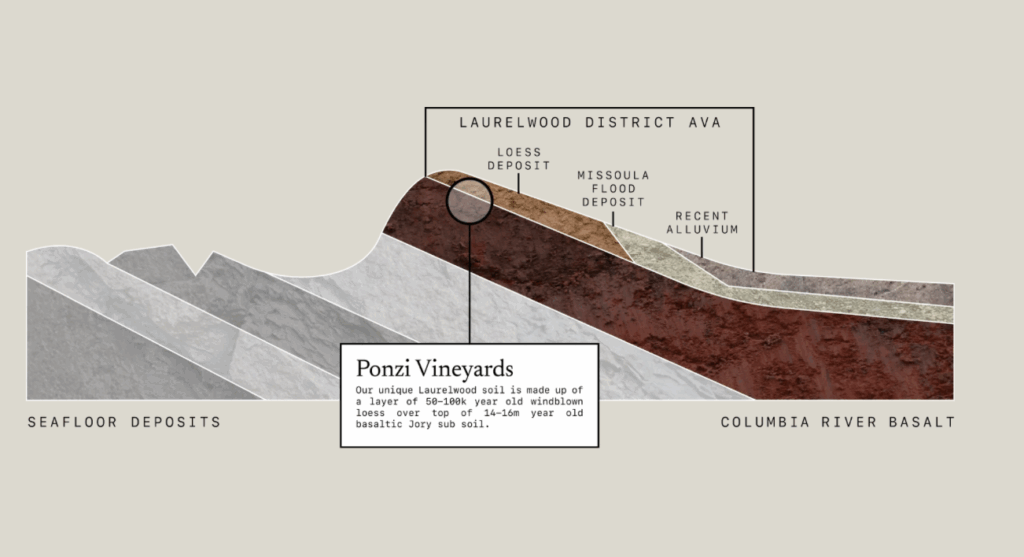
Laurelwood means windblown loess over basalt (with Jory soils): “spice and salinity,” structure and intensity. Younger vines, still in the surface loess, give red fruit; older ones, which have reached the basalt, give dark fruit (dried fig, blackberry) and more structure. In the Chardonnay the signature is white florals (“citrus blossom and honeysuckle and magnolia and dogwood”) and salinity on the palate: “You feel the mountains.”
Fermentations are native, in open-top stainless steel tanks of two to three tons: about two weeks, with tastings even three times a day until the tannins have polymerized. Thanks to the gravity-flow winery, the wine is drained overnight and pressed the next day, reducing the risk of vegetal notes. Malolactic starts on its own in barrel. The Laurelwood Cuvée spends 10 months in barrel and then goes to tank for blending, while the single vineyards and Reserve go to 16-18 months, with a second phase in neutral barrels. The Chardonnay ferments in barrel and stays 12 months in its original vessel: each barrel is tasted to decide what gets racked clean and what stays on the lees. “Nothing we do is formulaic.” Volumes are small: 100-150 cases of each single vineyard and 1,000-2,000 of the Laurelwood Cuvée, with concrete trials because it adds “another layer of tension.”


In the glass
Pinot Noir Laurelwood District, Willamette Valley
2023 | 94/100 – Lighter in color than the 2024. Balsamic nose, with currant, blackberry and fresh cherry. Fresh, harmonious, pleasing palate, with a little oak still perceptible; cherry returns on the finish, along with a floral note.
2024 | 95/100 – The vintage of the optical sorting, with greater focus on the best fruit and wider variability in berry size and ripeness. Intense color with a transparent rim. Dark nose, very balsamic, with currant, barberry, blue fruit and dried flowers. Gentle tannins, already polymerized; deep, round palate, with hints of oak, very long and precise, nicely concentrated. Linear, round, very open.
Pinot Noir single vineyards
Madrona 2023 | 93/100 – Very pale color, with a slight transparent rim that hints at evolution. Intense, dark nose, with red fruit, spice and cherry. On the palate tannin driven by the wood ageing, very rich, great acidity and soft earth notes.
Abetina 2023 | 94/100 – Floral, with cherry, currant and red berry fruit. Agile, ethereal, fresh and luminous: very fresh but with substance, very rich but elegant, deep yet agile.
Chardonnay Laurelwood District
2024 | 93/100 – Tropical nose, with orange blossom and botanical notes. Very rich yet broad, delicate yet very persistent, with elegant finesse. A blend with no recipe, from single neutral barrels with direct barrel fermentation, giving each wine a different tension.
2023 | 93/100 – Nose of warm sun and warm citrus, very intense, with flowers, orange blossom, botanical notes, lychee and tropical fruit. From old estate vines, with heritage and Dijon clones. Extraordinary acidity, linear, with no breaking points. On the palate great acidity, salinity, fine tannin and roundness, with a dark, earthy, intense finish.