
Beaux Frères
Deep in the forest
written by Erika Mantovan
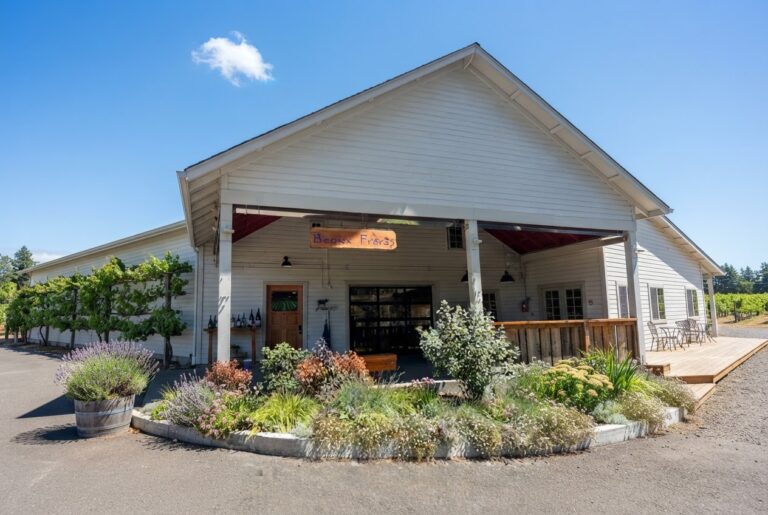
A winery that remains more or less as it was when it was founded. There have been a few recent upgrades to make it more welcoming, such as a parking lot. But what immediately catches the eye are the pigs near the entrance, the simple farmhouse architecture and an infectious sense of spontaneity.
Then there is the fact that the renowned American critic Robert Parker Jr. was among the original investors, and that his involvement remained largely under the radar. That alone makes the winery, even before Oregon as a whole, all the more intriguing.
As the winery team tells us, Parker was always very cautious and impartial in his ratings, seeking to avoid media overexposure and conflicts of interest as much as possible. Judging by the wines tasted today, however, the style now leans more toward tension, dynamism and an extraordinary sense of place than toward the structured, rich and powerful expressions that may have characterized the 1990s.
Equally striking is the transparency surrounding research into clones, individual plots and analytical data across the vineyards. The depth of information and the precision of the mapping are truly impressive.

The real-estate listing
To understand where all this comes from, we need to go back to 1986. Michael G. Etzel, then a wine salesman in Colorado Springs, set out for Oregon with his young family after reading an enthusiastic review of a 1983 Pinot noir from the Willamette Valley. During the trip they took a spontaneous detour to see a foreclosed 88-acre pig farm, about twenty minutes from their intended destination.
“We called a real-estate agent for fun and went to take a look,” recalls a member of the team today. At the top of the dirt road they found a hillside, a small bungalow and lush pasture. That was when the possibility of leaving behind their previous life to grow grapes for Oregon’s emerging wine scene began to seem real.
The price was $129,000 for everything – including sixty pigs, jokingly said to be the ancestors of those still wandering near the entrance today. The project took shape with financial backing from Michael’s sister Pat and her husband, wine critic Robert Parker Jr. The family connection also inspired the name Beaux Frères, the French expression for “brothers-in-law.” At the time, Oregon’s wine scene was concentrated almost entirely farther south, around Dundee. Instead, they invested in a little-known ridge called Ribbon Ridge, much of it still covered in woodland.
Rare soils
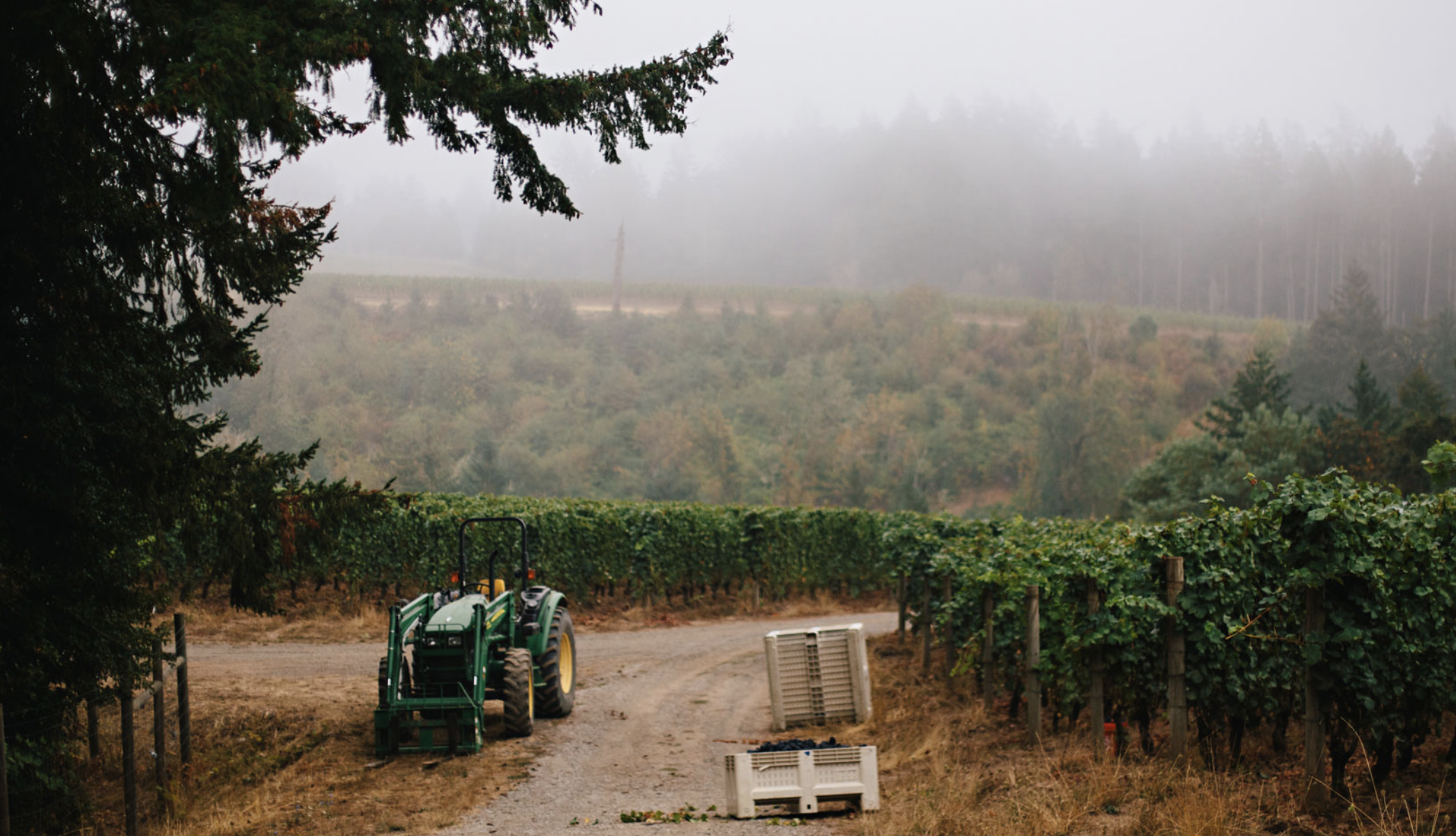
The land had been a dairy pasture and had never been planted with vines. The Etzel family moved to the farm in the summer of 1987, with three young sons in tow. In 1988, Michael planted the first five acres of Pinot noir at the crest of the property, at a density of approximately 2,200 vines per acre.
The first plantings included Pommard and Wädenswil clones, followed in the early 1990s by Dijon selections and so-called “suitcase clones.” This marked the birth of Beaux Frères Vineyard. While establishing the vineyard, Michael worked four harvests at Ponzi Winery, gradually building the experience required to turn a grape-growing project into an independent winery. The first crop arrived in 1990. Most of the fruit was sold to Ken Wright and Dick Ponzi, with only enough retained to make a single barrel. Between 1991 and 1992, the old barn was converted into a working winery. The first commercial vintage was produced in 1992 at Dick Ponzi’s winery in the Chehalem Mountains. The 1993 vintage was the first to be grown, made and bottled entirely on the Beaux Frères property. Traces of that original barn can still be seen today in the building that now houses the offices.
One of our guiding principles is to remain a family farm.”
Beaux Frères lies near Newberg, within Ribbon Ridge, which was officially recognized as an AVA in 2005. It is the smallest AVA in the Willamette Valley and, according to the estate, is characterized by a striking geological consistency, dominated by the marine sedimentary soils known as Willakenzie. The name WillaKenzie combines Willamette and McKenzie, two of the region’s rivers. These soils give the Pinot noir wines depth of structure and considerable ageing potential. Ribbon Ridge generally sits between 400 and 600 feet above sea level. Its moderate climate encourages early growth in spring, consistent and even ripening throughout summer and a generous maturation period in autumn.
We believe that the health of the forest has a very positive influence on the vines, both through temperature regulation and through its wildlife.”
Mikey Etzel takes the reins
In 2017, Michael Etzel needed to find new partners. He found them in a group with deep Burgundian roots: Maison Henriot, the historic Champagne house that also owned the négociant Bouchard Père & Fils and the Chablis producer William Fèvre. Henriot acquired a controlling stake, while Etzel and Parker retained a financial interest in the estate. The Henriot group later became part of Artémis Domaines, the Pinault family’s wine holding company. In 2023, Beaux Frères formally joined a portfolio of renowned estates including Château Latour, Clos de Tart, Domaine d’Eugénie, Château-Grillet, Champagne Jacquesson, Bouchard Père & Fils and Eisele Vineyard in Napa Valley. Michael G. Etzel remains a founding partner.
Throughout this journey, the objective has always been to preserve the soul of the place.”
Michael still lives just below Upper Terrace. His son Mike “Mikey” D. Etzel, the middle of Michael’s three sons, lives with his own children in the house built in 1996, where he spent his teenage years. More than thirty years after the family’s chance encounter with the property, three generations of the Etzel family now live on Ribbon Ridge.
Mikey has called the estate home since childhood, spending several decades immersed in its vineyards and daily life. He took over as head winemaker in 2016 and, following his father’s retirement in 2023, assumed broader responsibility for the estate as CEO and Technical Director. As his role expanded, Mikey decided to entrust the day-to-day work of winemaking to Damien Lapuyade, formerly the winemaker at Evening Land Vineyards.
Mikey has a deep love for purity of fruit, and that is precisely where the new direction is heading: the large punch-down pistons are gone, replaced by gentler pumps designed to produce ‘long-chain’ tannins – deep, but never aggressive.”
This gentler approach to extraction is followed by ageing entirely in french oak, of which between 30 and 40 percent is new. The remainder consists of barrels between one and five years old. Once the wine has achieved the desired balance of flavour and texture, it is gently drained from the skins and recombined with a proportion of the press fraction before going into barrel with its fine lees. Secondary fermentation takes place naturally and slowly in barrel. According to the estate, this extended process contributes greater complexity and allows for a very limited reliance on sulphur additions.
The vineyards and the sense of place
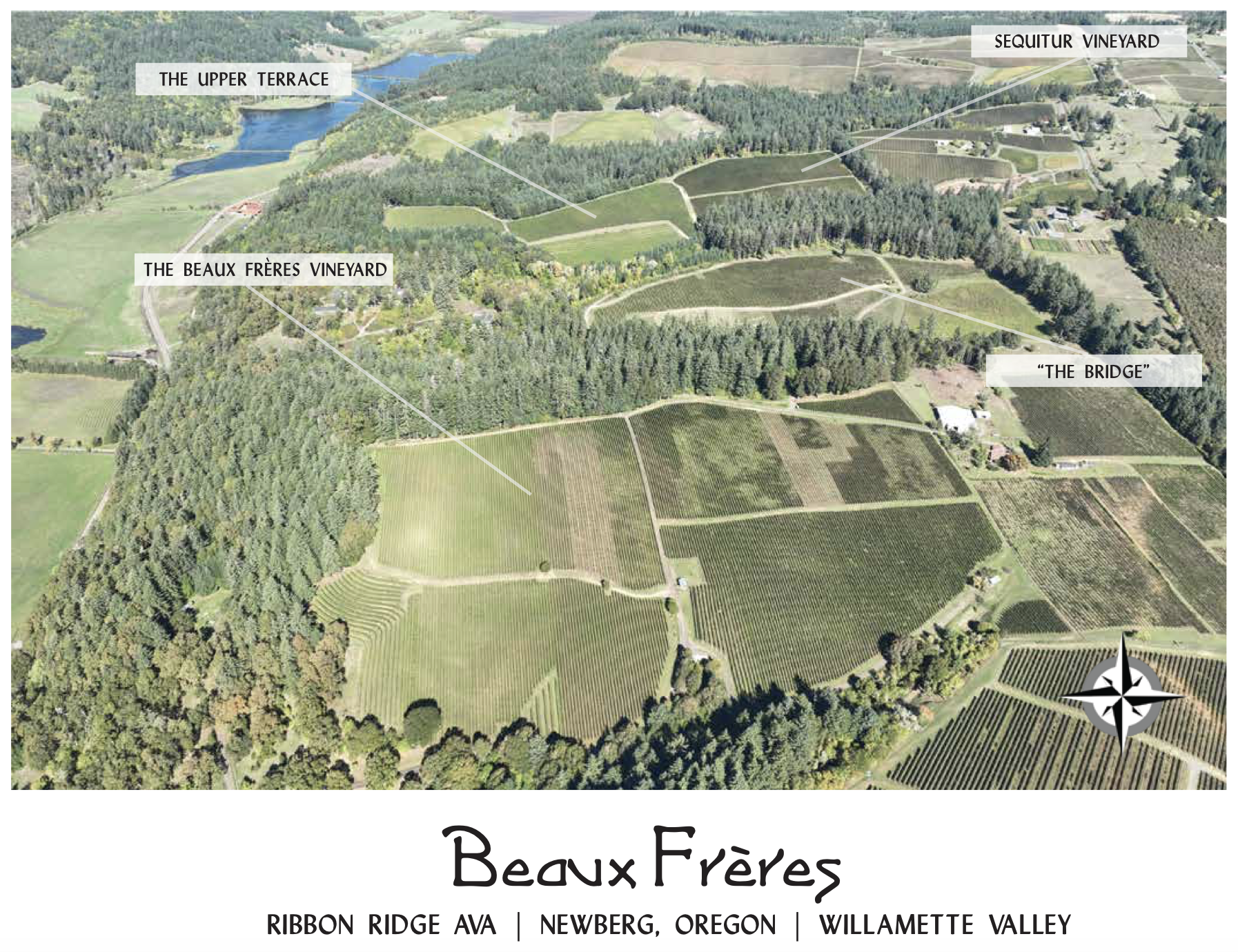
The original 88-acre farm was later expanded through the acquisition of an additional 40 acres on Ribbon Ridge in 2000. Thirty of those acres were restored to native Douglas fir forest, while the remaining ten became Upper Terrace Vineyard. The dominance of the forest is therefore not simply a remnant of the property’s past, but a deliberate agricultural choice.
The estate now extends across more than 70 hectares between its historic properties, but only a small portion is actually planted with vines. Beaux Frères Vineyard occupies 26 acres, just over 10 hectares, on a steep, continuous hillside facing southeast, south and southwest, at an elevation of approximately 400 feet. Upper Terrace Vineyard adds another nine acres, around 3.6 hectares, on the adjacent hillside.
A third property has recently been added to these two historic estates. It is still so new that it does not even have an official name: on the estate, they simply call it “the bridge” because it literally connects the other two. This was made possible by the purchase of an old dairy farm nestled between the two main vineyards, finally making the estate a contiguous property. For now, it comprises just four acres planted with Chardonnay and, pending a definitive name, appears on the label simply as “Estate.”
The original vineyard, first planted in 1988, had to be largely replanted after a phylloxera outbreak in the late 1990s. Only one row survived: the very first ever planted, still preserved in a corner of the vineyard.
The replanting was carried out using a massal selection developed on the estate according to biodynamic principles, an idea introduced by Mikey when he arrived as vineyard manager in 2015. Curiously, this means that the average vine age at Beaux Frères Vineyard is now younger than at Upper Terrace, the estate’s second historic vineyard, planted in 2000 exclusively with Dijon clones.
In the glass, the 2023 Beaux Frères Vineyard Chardonnay (95/100) stands out for its balance and purity. It is rich but never heavy, with lively acidity maintaining tension throughout and a distinctly savoury finish. Iodine-like tension, ginger and saline nuances.
Alongside the estate’s own production are several other important projects. Sequitur is the private vineyard of Michael Etzel and his wife, Carrie Critchlow: twelve acres planted with seventeen different Pinot noir clones, forming a genuine genetic map conceived with the future of the variety in Oregon in mind.
The 2023 wine combines great complexity with dark weight and substantial density. Aromatically, it is balsamic and botanical, with “the freshness of a forest” rather than of the forest floor (95/100).
Then there are Star Moor and Doration, two sites near the Chehalem Mountains AVA. They are not owned by the estate but are farmed by Mikey Etzel. He identified them with a geologist friend because of the presence of a rare volcanic soil known as Witzel.
Another recent development is the estate’s first organic certification, achieved after nearly three decades of organic farming practices.
Beaux Frères Vineyard: a bridge to Burgundy
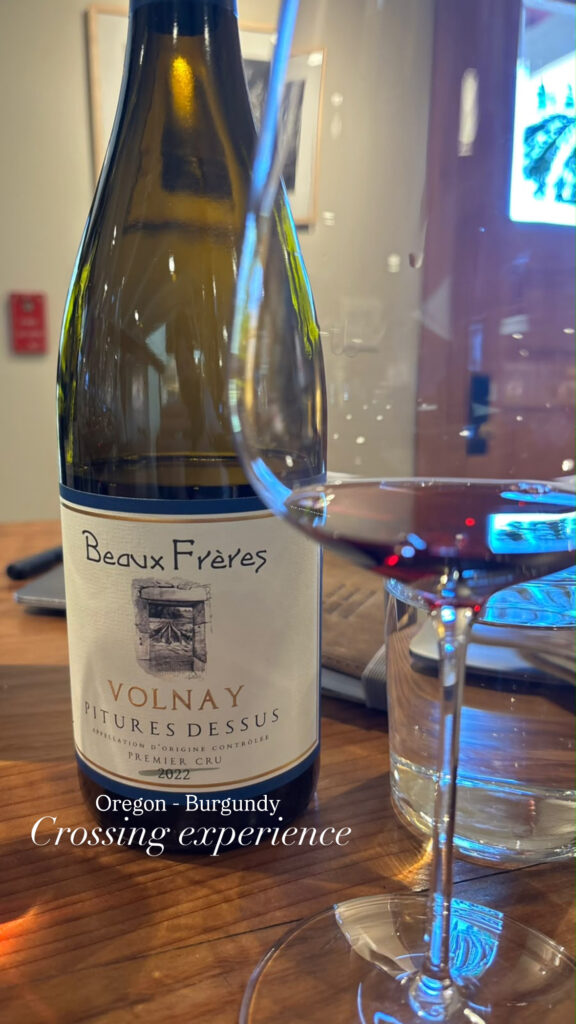
In 2020, a long-awaited and unusual project for an Oregon winery took shape: a collaboration with Bouchard Père & Fils to produce wine in Volnay. In February, Michael and Mikey flew to France to prune two parcels: Pichiers de Suisse and a walled section of Clos Rougeaud in Bouchard-Frémiet. They worked alongside Frédéric Weber, Bouchard’s winemaker. From early spring 2020, and for two consecutive harvests, the American team was unable to be physically present in France. Paradoxically, this made the undertaking even more collaborative, as it relied entirely on Weber’s work. The resulting vintages reveal different expressions of Pinot noir. The 2023 wine (96/100) is elegant, with a silky tannic texture and an integrated, highly tactile and profound palate. Orange peel, eucalyptus and wildflowers.
2020: the vintage no one wants to discuss
The 2020 vintage has been described as “deeply traumatic.” Wildfires covered Oregon in a blanket of smoke for an entire week, making the decision to produce only one wine almost unavoidable.
The fruit used had been brought into the winery before the smoke descended, and both primary and secondary fermentation were already under way in barrel.
Honestly, it could have been one of the great vintages. No one likes to talk about it; it is a stigmatized vintage.”
In the glass, the Chardonnay they produced is surprising: broad on the palate, with balsamic notes, generous richness and dynamic elegance. It speaks of a warm vintage while remaining decidedly fresh in the glass (94/100).