
Arctic Barolo: the first Barolo aged beneath Norwegian waters resurfaces
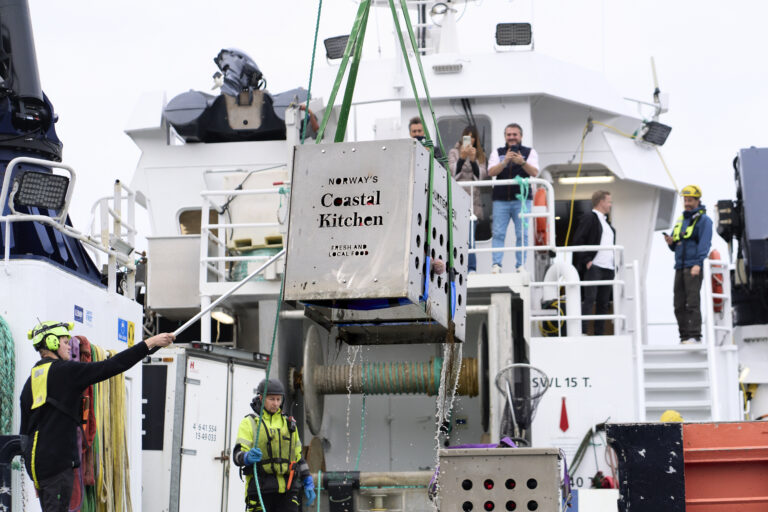
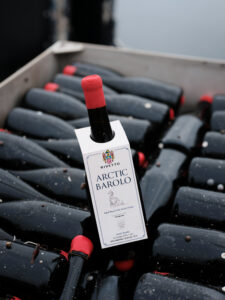
After spending twelve months at a depth of 34 metres in the Norwegian Arctic, 1,002 bottles of Rivetto Barolo 2021 have now returned to the surface. Named Arctic Barolo, this experiment conducted in partnership with Hurtigruten has exposed one of Piedmont’s great wines to ageing conditions radically different from those of a traditional cellar.
©️Max Emanuelson
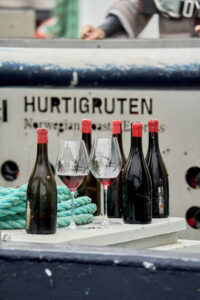
From the hills of Serralunga d’Alba to the icy waters of northern Norway, the journey is certainly an unexpected one. In September 2026, 1,002 bottles of Rivetto Barolo were recovered from the sea off Kirkenes after spending a year submerged at a depth of 34 metres, at 70° North. According to those behind the project, this is the first Barolo to have been aged in Arctic waters.
Behind the striking imagery lies, above all, an experiment exploring the evolution of wine. At this depth, the bottles spent twelve months at a near-constant temperature of 5–6°C, in complete darkness and under pressure of around 4 bar. These conditions differ significantly from those found in a conventional cellar.
A 2021 Barolo from Serralunga d’Alba as the starting point
For the experiment, Rivetto and Norwegian shipping company Hurtigruten selected the 2021 Barolo Comune di Serralunga d’Alba. The Piedmont estate, certified organic and biodynamic, had already taken the wine through its usual winemaking and ageing process, including 24 months in large oak casks. Submersion therefore does not replace the traditional ageing of Barolo: rather, it represents an additional stage designed to observe how the wine evolves in bottle within an unusual environment.
It is above all the comparison carried out after twelve months that makes the project particularly interesting. Once recovered, the submerged bottles were tasted alongside the same 2021 Barolo, which had spent the corresponding period in Rivetto’s cellars. The comparative tasting was led by Henrik Dahl Jahnsen, President of the Norwegian Sommelier Association. According to him, the differences were clearly perceptible: Arctic Barolo showed a brighter, more youthful ruby colour, together with a fresher, more precise aromatic profile centred on wild fruits and flowers. The tannins also appeared fresher and crunchier, giving the wine an overall more youthful expression than the conventionally stored bottle.
When the sea becomes a cellar
This experiment echoes a subject that VertdeVin has already explored on several occasions, in France (the Loire, Arcachon Bay, etc.), in the United States (Sonoma, the Finger Lakes, etc.) and, most recently, with Cantine Carputo in the Gulf of Naples. There too, bottles spent twelve months beneath the surface, although at a depth of 40 metres, in water at around 12°C and under pressure close to 5 bar. Comparison with conventionally aged wines revealed differences, notably in the finer mousse and more pronounced saline expression of the Metodo Classico Voce ‘e Notte, as well as in the brighter fruit and tannic profile of the red Ammore. With Rivetto, however, the experiment moves to an entirely different latitude, and almost another world. The Mediterranean waters of the Gulf of Naples give way to the Arctic, with temperatures around 5–6°C, roughly half those recorded in the Neapolitan experiment. The principle remains fascinating: to place the same wine in a radically different environment and observe whether its rate of evolution is altered.
Does submersion slow the evolution of Barolo?
This is precisely the question raised by the first comparative tasting. Rivetto is careful, however, not to draw any definitive
©️ Kristian Dale
conclusions. Instead, the experiment opens up a broader discussion about the respective influence of temperature, pressure, darkness and, more generally, the storage environment on the evolution of wine.
Such caution is important. An organoleptic difference observed between bottles is not, in itself, sufficient to isolate the precise role played by each of these parameters. Nevertheless, it provides a particularly interesting field of observation for a wine such as Barolo, whose capacity for long ageing is an essential part of its identity. From Naples to Kirkenes, these underwater experiments therefore raise the same question in very different environments: can the sea alter the pace at which wine evolves in bottle?
From the Langhe to the Arctic
For Enrico Rivetto, the project is also a way of placing a wine deeply rooted in its place of origin within an environment thousands of kilometres from Serralunga d’Alba. The Barolo remains an expression of the Langhe, but its Arctic sojourn offers a different perspective from which to observe how it evolves after bottling.
The story will not end with the experiment. Bottles of Arctic Barolo will now be served exclusively aboard Hurtigruten ships sailing along the Norwegian coast. Passengers will therefore be able to taste the wine while travelling through the very waters in which it spent twelve months. The underwater installation was also designed to be fully retrievable, and all bottles and structures were removed from the seabed at the end of the experiment.
With Arctic Barolo, Rivetto is not claiming to reinvent the ageing of Barolo. Rather, the project adds another piece to a question that a growing number of estates are beginning to explore: to what extent can the storage environment alter the pace and nature of a wine’s evolution in bottle?