
Château Montrose
A great terroir, a vineyard of tomorrow
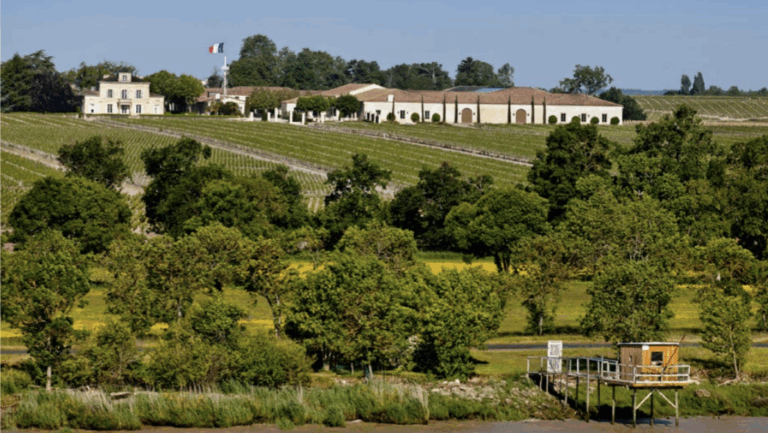
Two hundred years ago, the Château Montrose vineyard was covered not with vines, but with pink heather. Sailors saw this hill from the estuary and named it ”Mont Rose” (“Pink Hill”). Today, vines flourish there, yielding the fruit for one of the greatest wines of the Médoc.
A plateau terroir at the heart of the grands crus
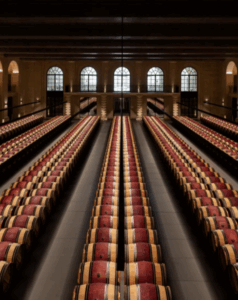
In 1815, Étienne Théodore Dumoulin sensed the great terroir here and founded a wine estate, keeping the historic name of the land. In just 40 years, in 1855, it became the second youngest classified Grand Cru. An Alsatian, Mathieu Dollfus, took over the property in 1866, modernized its facilities, and created a village for his employees with ideal working conditions. A creation of Mr. Dollfus, the windmill, is now one of Montrose’s symbols, because it flooded the vineyards with groundwater, thus limiting the spread of phylloxera.
The Charmolüe family then took over the estate and guided it with distinction through difficult times. In homage to his mother, who managed the estate alone during the war, Jean-Louis Charmolüe created the second wine, ”La Dame de Montrose.” Today, the Château is part of Eutopia Estates, the group of the Bouygues family’s wine and agricultural properties in Saint-Estèphe, the Loire Valley, Burgundy, Cognac, and Virginia in the United States, as well as the Truffière de Cément, which produces truffles in the Loire Valley.
A Great Terroir Shaped by the Gironde
The lands of the Médoc, once covered by the ocean, were transformed by the formation of the Pyrenees, generating tectonic movements and faults, one of which became the Gironde estuary.
The alternation of glacial and warm periods caused its waters to advance and retreat for millions of years, accumulating deposits of gravel, clay, and sand, and eroding older layers.
This is how the six terraces of the Médoc were formed: vast, gently sloping plateaus, ranging from 5 to 45 meters in altitude, with a mosaic of soils and excellent drainage. These terraces slope down towards the wide Gironde estuary, which protects the vines from extreme temperatures and excessive rainfall.
These lands, ideal for the flagship grape of the Médoc – Cabernet Sauvignon – are meticulously studied at Château Montrose to implement a plot-by-plot approach. Its 95-hectare vineyard comprises 60 climats (vineyard sites), 26 soil types, and 115 parcels, each vinified separately and contributing its unique character to the blend.
“The essence of our great adventure lies in a deep and sincere respect for the land.” Charlotte Bouygues
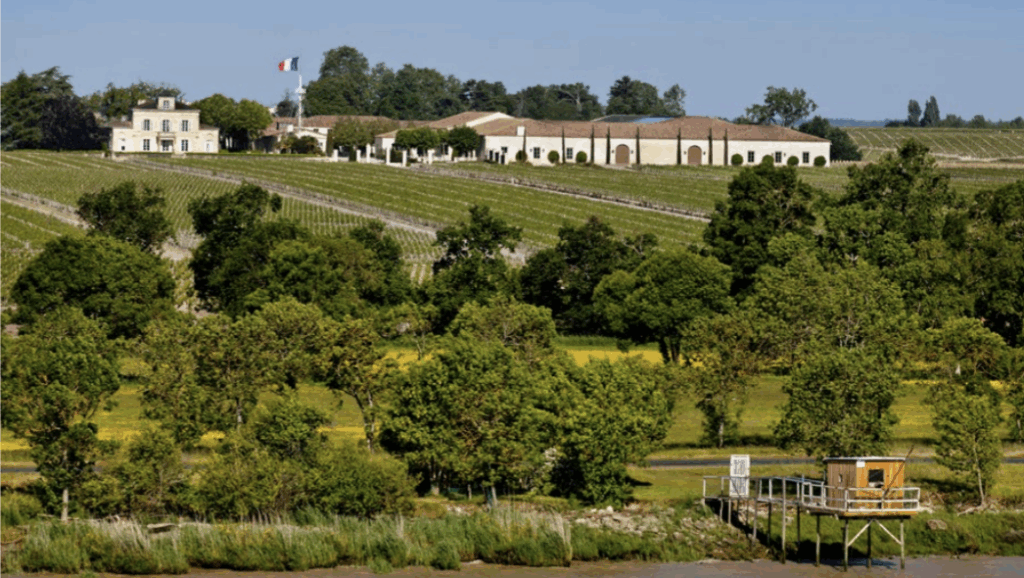
Terraces 3 and 4: the foundation of Montrose
The majority of the vineyard is planted on Terraces 3 and 4, with terroirs subject to distinct water constraints. The vine roots develop at a depth of 5 to 7 meters in the gravelly sands of Terrace 3, accessing water in deep clays mixed with gravel. On Terrace 4, the roots penetrate the sandy gravel and stop at a depth of 0.3 to 1.5 meters on ironrich crusts. They then develop on the surface and are nourished by capillarity, drawing water from the iron-rich layers that retain it and release it to the vine roots. Cabernet Sauvignon thus offers two
complementary expressions: depth and purity on Terrace 3, and energy and complexity on Terrace 4.
Since the 2023 vintage, the Grand Vin of Château Montrose has been made exclusively from
grapes grown on Terrace 4, in order to preserve its connection to the Château’s original terroir. The plots on Terrace 3 are now dedicated to a separate cuvée, ”Terrasses de Château Montrose,” to express this facet of its vineyard.
“Montrose 2070” – A Vision of the Vineyard of Tomorrow
In 2006, the Bouygues family initiated the renovation of the Château, respecting its history and the quality of its wines. This renovation aims to model viticulture of the future with minimal intervention, the use of photovoltaic panels to meet energy needs, the construction of low-energy consuming buildings, and the reduction of the carbon footprint. It also involves the application of regenerative agriculture to maintain biodiversity and soil regeneration, the use of lightweight robots to prevent soil compaction, and research into alternatives to copper treatments.
Finally, this viticultural model embodies innovation while preserving the DNA and heritage of winemaking. In other words, the long-term viability of Château Montrose in the face of the climate emergency, which is bringing forward harvest dates, will be ensured not by choosing new grape varieties, but by massal and clonal selection within its vineyard and by adapting its management practices. Innovating, creating its own viticultural model within the current climate reality, without abandoning its identity, is the motto with which the Château moves forward.