
Almaviva
Puente Alto: a benchmark high-altitude wine born of two continents
Within Chile’s fine wine landscape, Almaviva stands as one of the most complete and coherent ventures of modern viticulture. Established through a partnership between Baron Philippe de Rothschild and Concha y Toro, the estate is driven by a clear ambition: to craft a Bordeaux-inspired blend while delivering a precise and authentic expression of Chilean terroir. As the winemaker succinctly puts it, “it is the meeting of two worlds.” On one side lies Bordeaux’s technical rigour and stylistic discipline; on the other, the raw energy of Chile’s landscape, stretching from the Atacama Desert to the glaciers of Patagonia. This diversity finds a more focused expression in the Maipo Valley, the historic heartland of Almaviva.
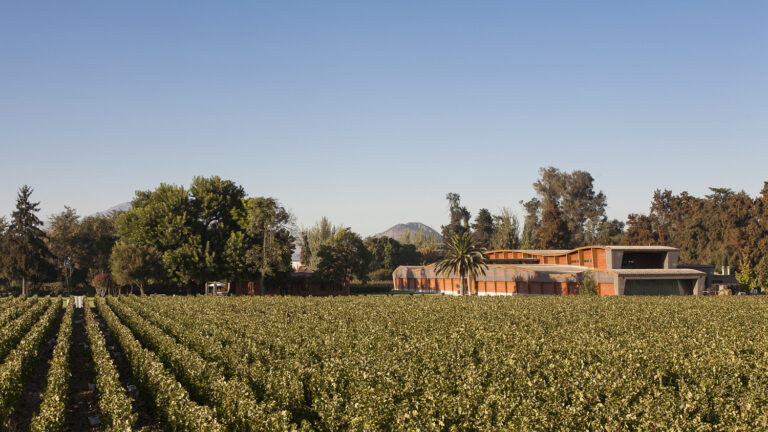
The vineyard is located in Puente Alto, on the northern bank of the Maipo River, at approximately 650 metres above sea level, at the foothills of the Andes. Among the valley’s coolest sectors, Puente Alto has long been recognised for its outstanding Cabernet Sauvignon. Here, however, the ambition extends beyond varietal expression. “We were not seeking a New World Cabernet,” the team emphasises, “but rather a structural backbone for a great blend.” First planted in 1978, the vineyard today spans around 65 hectares, exclusively dedicated to Almaviva. The varietal composition is resolutely Bordeaux in spirit, with Cabernet Sauvignon at its core, complemented by Carménère, Cabernet Franc, Merlot and Petit Verdot, enabling blends of precision, depth and complexity.
Climate is central to this pursuit of balance. Shielded by the Andes to the east and the Chilean Coast Range to the west, the vineyard is largely protected from direct maritime influence. Unlike regions such as Napa Valley, where coastal fog can penetrate inland, the Pacific’s cooling effect is here naturally moderated. By contrast, the Andes exert a defining influence. Each evening, cold air descends from peaks rising to nearly 7,000 metres, ensuring a gradual and even ripening cycle. This diurnal cooling effect preserves acidity, enhances aromatic definition and underpins the wine’s hallmark finesse. The semi-arid Mediterranean climate, with approximately 300 mm of annual rainfall concentrated in winter, minimises disease pressure and allows for highly controlled vineyard management. Marked day–night temperature variation during the growing season further supports slow phenolic development and optimal concentration.
The soils reinforce this identity. Alluvial in origin, they are composed of poor, stony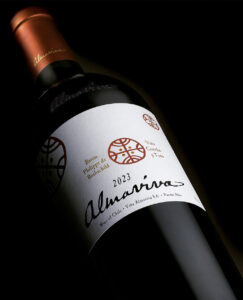 substrates, with silty-clay topsoils overlaying deeper layers of sand, gravel and rounded stones. This structure provides excellent drainage, naturally restrains vigour and encourages deep root penetration. The resulting fruit shows notable precision, structural tension and a distinctive mineral edge, all contributing to the wine’s elegance and ageing potential.
Chile’s unique status as a phylloxera-free country also plays a role. As the team notes, the absence of phylloxera has allowed certain vines to remain ungrafted, a rare condition that may enhance the purity and transparency of terroir expression.
While Bordeaux remains a constant reference point, it is never imposed. The philosophy is one of balance: achieving full phenolic ripeness while preserving freshness and refinement. The objective is clear, to produce a wine capable of long ageing without ever compromising finesse.
Almaviva’s identity extends beyond the glass. Its name, proposed by Jean-Pierre de Beaumarchais, pays tribute to Count Almaviva, the emblematic character created by Pierre-Augustin Caron de Beaumarchais. The label, meanwhile, draws on Mapuche symbolism, notably the “Meli Witran Mapu”, representing the four cardinal points, the seasons and the natural elements. It serves as a visual expression of the estate’s connection to place, history and cultural heritage.