
Winemaking : a risky business
Few people think of winemaking as a hazardous occupation. But danger lurks everywhere: in the cellar, winemakers die from asphyxiation, drown in their vats and get crushed by rolling barrels. Even the vineyard is everything but safe. More often than not, the winemaker is himself the greatest danger.
When it happened there was a rough rumble and the ground around the warehouse slightly quaked under the feet. On 4 May 2021, a thin steel leg underneath a vat buckled under the weight of more than 50 tonnes of metal and liquid. The tank in the warehouse of Darling Cellars (Western Cape, South Africa) tipped over a second one, starting a rippling, unstoppable domino effect. Several vessels broke through the outer walls of the winery, tearing stairs, walkways and pipes along with them. Through the shattered concrete walls, 250,000 litres spilled spectacularly; photos of the incident resembled a Titanic-like disaster, with employees fighting metre-high red fountains before the stainless-steel containers fell on top of each other and remained lying there, like oversized toys. «Traumatic», managing director Riaan de Waal said later, but ”it could have been much worse.”
Albeit a rare disaster, this was not one of a kind. In 2020 a 380,000-litre tank burst at Rodney Strong Winery in California, turning the courtyard and nearby Russian River red. Residents of the small village of Cafayate in Salta, northern Argentina, also refused to believe in a miracle when the nearby Santa María River turned purple. A broken pipe in the vineyards was to blame. Fortunately, wine is much less harmful to nature than chemicals and no one was hurt. In the cellar, however, accidents involving people happen more often than one might think. When tanks are cleaned, for example, and an agitator inside starts moving, it gets dangerous. Traditional barrels are stacked in rows on top of each other and usually secured with wedges. Even a small barrique weighs around 270 kilos when full. If a wedge comes loose, a few tonnes can start moving faster than a man can run.
Death in a tank
The idea of a winemaker falling into a tank and drowning might seem like something out of an old-fashioned crime novel. But it is far more real. This last September, Philippe G., a winemaker from Muscadet in northwestern France, died after falling into an underground wine tank midway through fermentation. As is often the case, the exact circumstances remain unclear, since there was no one else at the scene. G. was a fit sportsman; but if tanks are only filled to the point where a person can no longer reach the top edge, not even the fittest can save themselves. In a similar but more fortunate case, a worker at a Beaujolais cellar fell into a vat and remained trapped until the fire brigade came to his rescue.
Wines that unintentionally begin to ferment in closed tanks accumulate high carbon dioxide, which escapes explosively when a closure flap is opened or bursts due to the pressure. Even pressure-tanks for sparkling winemaking can burst. When 30,000 litres of Prosecco bubbled uncontrollably across a farmyard in Veneto in 2018, the producer was not in a party mood.
CO₂ can also be life-threatening without pressure. The gas produced during the fermentation of wine must is five times heavier than air and flows into rooms below through walls and cracks. It settles on the floor and accumulates, displacing the air. If the odourless gas rises to head height, it becomes life-threatening. In 2021, family members were working in an unventilated fermentation room in Calabria. A reconstruction of the accident suggested that one man fainted first. A second man tried to rescue him and lost consciousness as well; then a third. In the end, four people died. A woman was found near the door and narrowly survived. ”People die every year, entire families have been wiped out,” confirms Gabriela Würth from the General Accident Insurance Institution in Vienna. Popular wisdom is that when a candle goes out, the air becomes scarce. Winemakers should not rely on this, though. Air contains 0.04% CO₂. “At 5%, you pass out”, explains Würth, “9% are lethal”. Candles still burn at a CO₂ content of 13%.
Dangers lurking in the vineyard
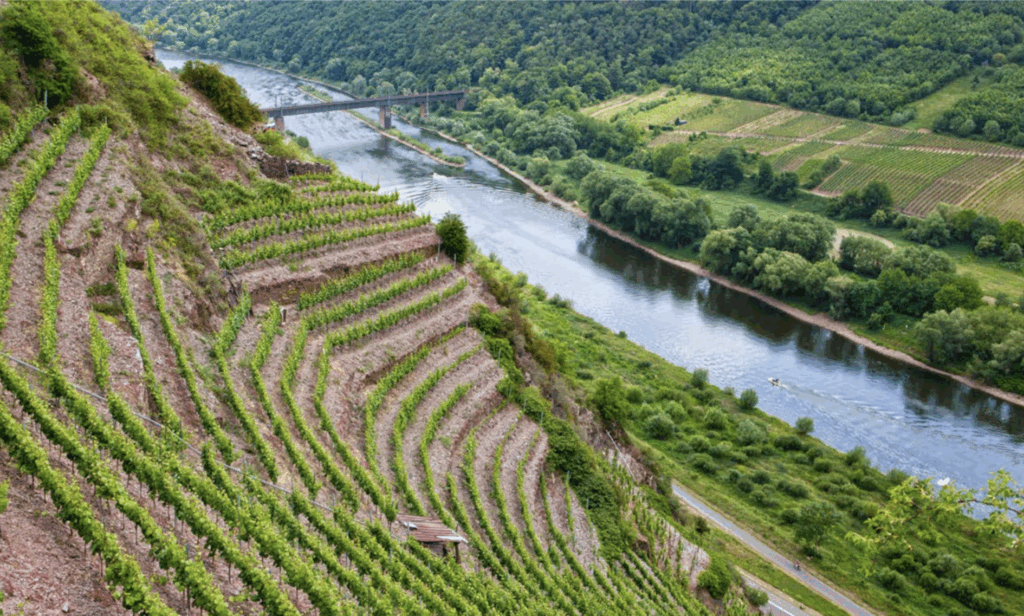
Other threats lurk in the vineyard. The machines used by winegrowers have real potential to cause injury: rotating blades, rams and shredders represent severe potential occupational hazards. Accidents involving tractors can sometimes be fatal. Anyone who gets caught under a harvester weighing several tonnes has virtually no chance of survival. On the steep slopes of regions like Alto Adige, Wallis, the Jura or the Mosel winegrowers often use crawler tractors. The tracked vehicle drives down the row of vines from above and is additionally secured to the tractor standing above the row with a steel cable. An ingenious invention for slopes with gradients of over 60 degrees. However, winegrowers sometimes overlook wear and tear. If the cable breaks at a weak point, the impact can be fatal.
Many machines used in viticulture have a high potential for injury: post drivers can smash both wooden posts and bones; pneumatic and electric shears can be triggered unintentionally, and harrows and shredders throw vine parts and stones through the air. Tillers and cultivators with rotating blades and rollers continue to run even when hands and arms come close. Leaf removal and destemming machines are gentle on the grapes, but not on body parts.
High quality, high risk
Narrow tractors are probably the most common cause of death. Numerous attachments can be fitted at the front, sides and rear. This is why these manoeuvrable machines are a kind of all-purpose weapon in small-scale viticulture. When turning on slopes, their narrow track width quickly reaches its limits, and weight shifts caused by attachments further impair stability.
Once balance is lost, especially at the top of a row of vines, they crash all the way down into the valley onto the road. In Efringen (Baden, Germany) a vineyard tractor even came to rest onto the tracks of an ICE high-spped train. Fortunately, the train was able to break in time, with over 100 passengers narrowly escaping disaster. ”Regions with difficult topographical conditions are our biggest concern,” explains Dr Erich Koch, press spokesman for German social insurance body SVLFG. In other words, slopes are risk zones. But they are also some of those with the highest pedigree. Environmentally friendly winegrowers might turn to horses to eliminate the risk of accidents. But even a horse can have a moment of distraction, slip and pull its handler down the slope. It has all happened before.
In the air
When spraying pesticides, not every winegrower sits in an air-conditioned cabin. Glyphosate, the most abundant ingredient in herbicides, continues to be used extensively with EU approval, even though it is considered carcinogenic. French, Dutch and US studies found that the contamination in dust around vineyards was up to 1,000% higher than in sites where no pesticides were applied. Even where national laws prohibit it, many winegrowers continue to use it. There are hardly any controls or enforcement. Climate change is also affecting working conditions: during the 2023 harvest, five grape pickers died of heatstroke in the formerly cool Champagne region, when temperatures reached 35 degrees Celsius.
In California this has long been a familiar problem: Mexican harvest workers, who are used to the heat, only enter the vineyards fully covered up. Or not at all, because they fear being arrested by the Trump administration’s anti-immigration raids. Winegrowers who protect their workers face heavy fines.
Viticulture is a labour-intensive form of agriculture. This naturally increases the risk of accidents. Though almost every official from a region can give you multiple examples, there are hardly reliable figures. In Germany alone, there is an average of around 200 reported serious accidents and fatalities almost every year, while the number of accidents in agriculture as a whole is declining, according to SVLFG, the agricultural social insurance. At least statistically, hunters in Germany live more safely than winegrowers.
Written by Matthias Stelzig