
Douloufakis Winery
A Venetian Legacy in the Heart of Crete
Douloufakis is one of the finest interpreters of Cretan wine, a benchmark name within the island’s most prestigious appellation, the PDO Dafnés. The estate stands on solid foundations, now led by Nikos Douloufakis, the third generation of the family. The fourth generation has already joined the winery, contributing actively to recent harvests. The Douloufakis family traces its Venetian roots back to the noble Querini and Dolfin families, who settled in Dafnés between the 13th and 17th centuries – a lineage that intertwines Italian heritage with Cretan soil.
History and Italian tradition blend seamlessly with the contemporary vision of Nikos Douloufakis, who received his oenological education in northern Italy. After graduating in 1992 from the Alba School of Enology in Piedmont, Douloufakis joined the legendary Bruno Ceretto’s team, gaining firsthand experience in one of Italy’s most dynamic wine regions. He later honed his craft at Cascina Bruni and spent several years experimenting across Piedmont before returning home to Crete.
His first bottling came in 1996, reviving the cellar founded by his grandfather and later managed by his father. Today, Douloufakis Winery owns 25 hectares of vineyards and collaborates with another 25 hectares of long-term growers, producing roughly 400,000 bottles annually. The village of Dafnés, home to about 1,500 residents, lies twenty minutes south of Heraklion, the island’s capital. It forms the heart of the PDO Dafnés, an area encompassing twenty winegrowing communities. The appellation is primarily devoted to two native varieties: Liatiko, already recognized as PDO, and Vidiano, currently under review for protected status. Other indigenous grapes include Vilana, Muscat of Spina, Malvasia, and the extremely rare Tachtas for white wines, alongside Mandilari and Kotsifali for reds. Douloufakis also cultivates select international varieties such as Chardonnay, Sauvignon Blanc, Cabernet Sauvignon, Sangiovese, and Syrah – all of which have adapted remarkably well to Crete’s Mediterranean microclimates.
The vineyards lie between 350 and 450 meters above sea level, on calcareous, pale soils that reflect sunlight and retain moisture. These white, limestone-rich terrains lend Douloufakis wines their distinctive salinity, freshness, and finesse, hallmarks that define the estate’s style across its range.
“To avoid sunburn,” explains Nikos in flawless Italian – a language he never forgot – “we must protect the grapes from direct exposure during ripening. The top layer of foliage, supported by two higher wires spaced farther apart than those below, forms a kind of ‘umbrella’ over the clusters. This not only shields them from the harsh sun but also allows for proper ventilation. After all, here in Dafnés, the wind never stops blowing.”
The PDO Dafnés unfolds over four north–south valleys characterized by gentle slopes and, in places, steep hillsides with sea views to the north. Covering approximately 3,000 hectares, the region permits the production of PDO wines, PGI Crete (the equivalent of IGT), and generic table wines that fuel Crete’s vibrant “bag-in-box” market for local tavernas.
“Numbers have changed dramatically in recent decades,” Douloufakis observes.
“Once, olive trees covered about 30% of our hills and vines 70%. Today, the ratio is almost reversed. Many older growers passed on vineyards that were later abandoned by younger generations, who preferred to uproot vines and plant olive trees – far easier to manage.”
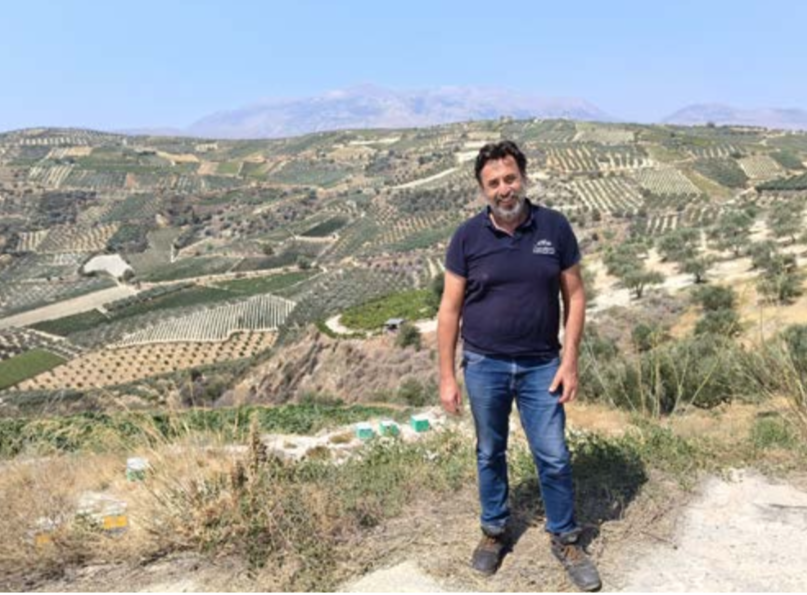
Land remains a prized asset in Dafnés, where agriculture is still the main livelihood. “A hectare costs around €50,000,” the winemaker notes, “though prices can drop significantly, even by half, the farther you move from the PDO’s core area.” Families like Douloufakis play a crucial role in preserving viticulture and reviving neglected vineyards, in a region where small, fragmented holdings are a structural challenge – much like in Italy’s traditional wine territories. “Our 25 hectares are divided into dozens of parcels”, says Douloufakis. “Large, contiguous estates are a dream here.”
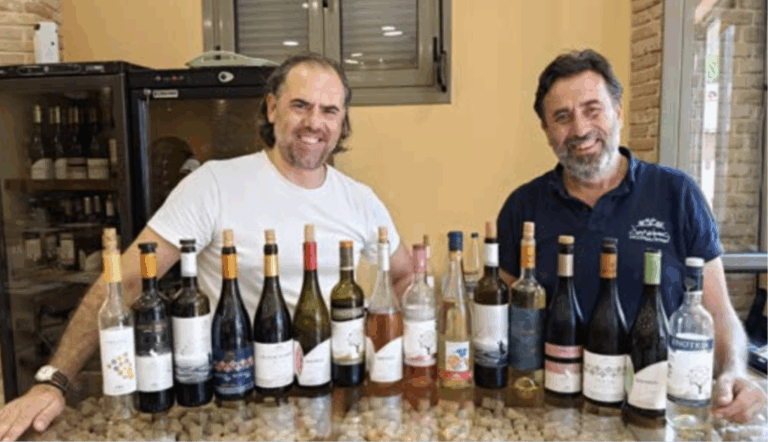
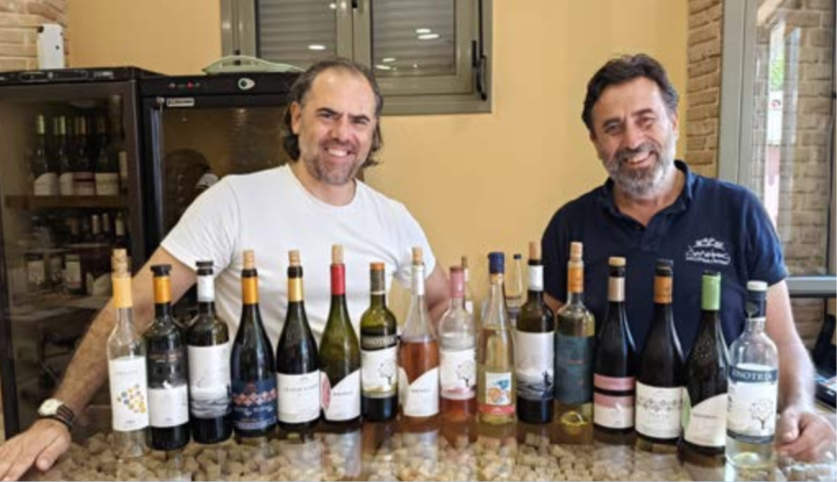
Douloufakis Winery’s portfolio is divided into three main lines. “Enotria” represents the entry level, approachable and vibrant. “Dafnios” focuses on native varieties, showcasing the character of Liatiko and Vidiano. Then there is “Aspros Lagos” – literally “White Hare,” after the local rabbit – the winery’s flagship and most experimental range, where oak-aged wines meet both indigenous and international grapes.
The “Alargo” series, whose name pays homage to the family’s Venetian roots, ventures even further into complex, refined territory, successfully blending Cretan terroir with grapes renowned beyond the island – including Assyrtiko, Santorini’s iconic variety, and Syrah, the international red that thrives under Crete’s sun.
Scattered throughout the range are genuine gems that highlight the versatility of Douloufakis’ favorite grape: Liatiko. Once believed to be related to Italy’s Aleatico – a theory DNA testing has recently disproven – Liatiko offers a striking range of styles. When vinified in stainless steel, it evokes the elegance of Pinot Noir; when aged in oak and matured in bottle, it can approach the depth and structure of a fine Nebbiolo from Barolo. These wines reveal not only the oenological potential of Cretan varieties but also their commercial promise – proof that Crete’s native grapes, once underestimated, can stand proudly alongside the great classics of Europe.